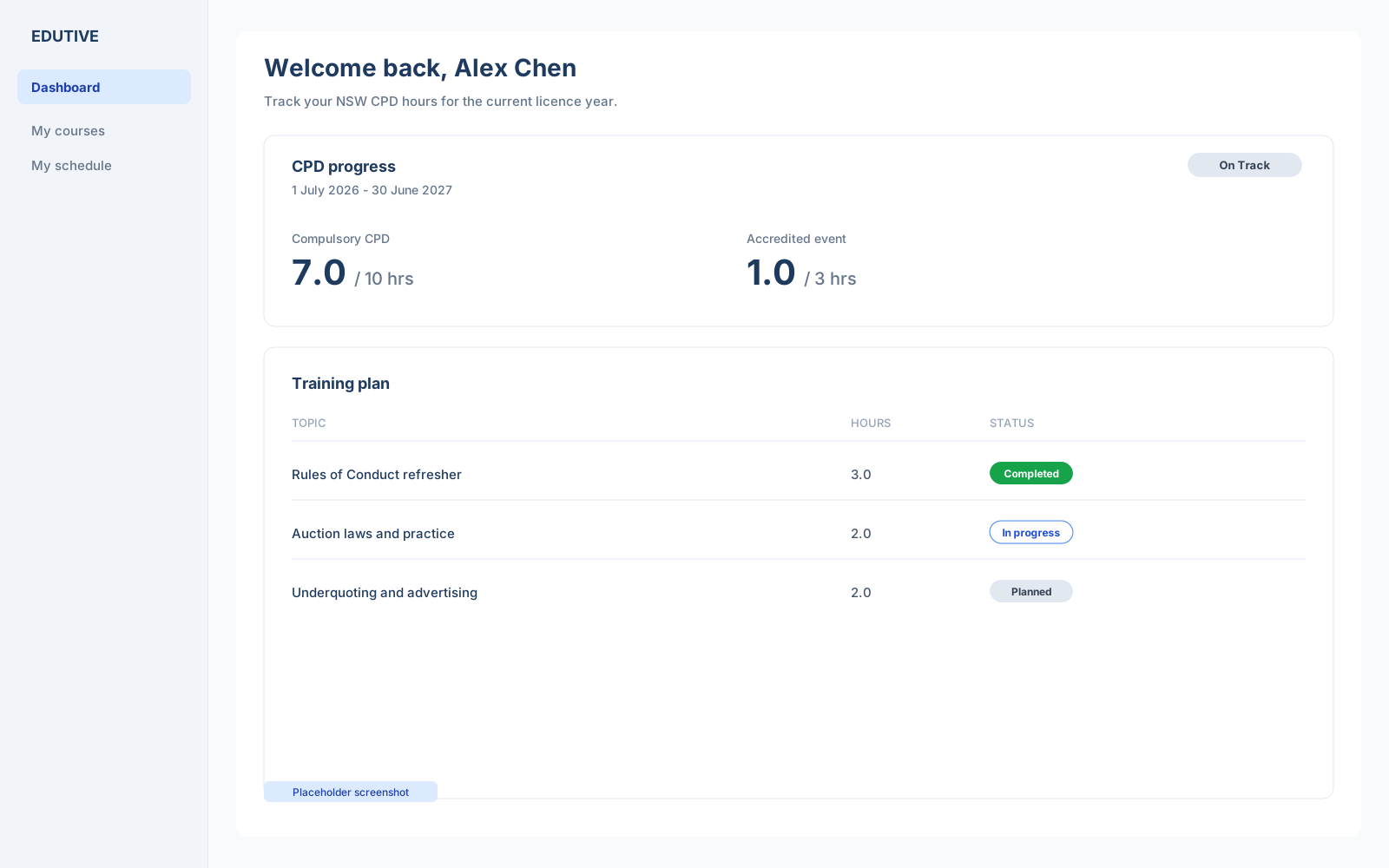


As a NSW licensee in charge, you keep two sets of CPD evidence. The first is your own: a record of every compulsory topic you’ve completed as a Class 1 licence holder, plus your accredited forum and, if your area of practice needs it, AUSTRAC’s AML/CTF course. The second belongs to the agency: the training plan, where you record each team member’s completed CPD once you’ve obtained and reviewed their records.
Your agents still keep their own records as well. Fair Trading says every licence and certificate holder must keep records of the compulsory topics they’ve completed and provide them to NSW Fair Trading if requested. Class 1 and Class 2 licence holders keep all records for 3 years; certificate of registration holders keep theirs for 4 years. Your office copy doesn’t replace theirs.
The rules sit on the official Fair Trading CPD page, and the current CPD year runs 1 July 2026 to 30 June 2027. This is a practical guide, not legal advice.
Two files, not one: yours and the agency’s
Your team’s files belong to them, and they take them when they leave.
The agency file belongs to the office, and you run it. Fair Trading makes the nominated LIC responsible for developing, implementing and updating the annual training plan. The Supervision Guidelines (section 2.4.2) then ask for a procedure for “monitoring and recording in the training plan the licensed agents and certificate holders who have completed their CPD, including by obtaining and reviewing records”.
In practice, a completion goes on your plan once you’ve seen the record and checked it. Not when someone mentions over coffee that they’ve done contracts. Still setting up the plan itself? Start with our guide to LIC training plans.
Your own evidence as a Class 1 LIC
An LIC holds a Class 1 licence, so your core CPD is the same as any Class 1 or Class 2 agent in your area of practice. On top of that come the accredited forum and, depending on your area of practice, AUSTRAC’s course. Keep all of it together, and when July comes round, start a new folder and leave last year’s where it is.
Compulsory topics for each area you work in
Keep a record of completion for every compulsory topic you finish with an approved provider. If you work across more than one area of practice, Fair Trading doesn’t make you repeat a shared topic as long as all the learning outcomes are met for each area. Note which areas a shared topic covered. Topic lists by pathway are in our NSW CPD requirements 2026–27 guide.
The accredited forum
Class 1 licence holders must spend at least 5 hours at a NSW Fair Trading accredited forum relevant to their licence category, on top of core CPD hours. Dual licence holders need only one forum in the year. Keep whatever confirmation of attendance you receive from Fair Trading or the approved provider that ran it. More in how Class 1 agents complete the accredited forum.
AUSTRAC’s AML/CTF course, if your area of practice needs it
If you’re a Class 1 residential salesperson, buyers agent, commercial agent, business broker or stock and station agent, you also need AUSTRAC’s Smart real estate agent’s guide to AML/CTF (property managers aren’t on that list). Keep the completion certificate if you did the self-paced program, or records confirming completion if you did it through train-the-trainer. It’s separate from the compulsory topic Supervision Guidelines and AML CTF in agency practice: two requirements, two pieces of evidence. More in Class 1 AUSTRAC training.
What should a staff CPD certificate show?
Before you mark anyone “complete” on the plan, open the record and check it. Fair Trading’s conditions of approval for CPD providers say an approved provider must give each participant a written record of completion, including an electronic copy, within 10 business days. It must show:
- the person’s name as shown on their licence, their licence number, email address and phone number
- the results of any assessment the topic requires
- the title of the compulsory topic completed
- the date, time and place it was done
- how it was delivered
- the duration in hours
- the type of assessment
- the name of the approved provider and the person who delivered the topic, plus ASQA registration details if either is registered with ASQA
- a written guarantee that the person named attended and participated in the course for its whole duration
If a document doesn’t show those details, it isn’t the record providers have to issue. Common stand-ins are an enrolment confirmation, a tax invoice, or a “certificate” from a self-paced module with no assessment result. Ask your team member for the provider’s actual record, and if 10 business days have passed since the session, chase the provider.
Then run three quick cross-checks:
- Right provider for that topic. The provider should be on Fair Trading’s 2026–27 approved list for that specific topic. Here’s how to check the approved provider list.
- Interactive, with an assessment. Compulsory topics must be delivered face-to-face (maximum 40 attendees) or by interactive webinar (maximum 25), and include an assessment activity. The record should say face-to-face or interactive webinar, and name the assessment.
- DFV from a provider cleared for it. For residential property managers, the Domestic and Family Violence topic can only be delivered where Fair Trading has reviewed the course content and assessment. Check the provider is approved for that course. More in what residential property managers must cover.
Last, check the name. If the record uses a preferred or former name that doesn’t match the licence, ask the provider to reissue it while the session is still recent.
What the agency file should hold for each person
For each person on the training plan, you want to see:
- name, licence or certificate number, licence category and area(s) of practice
- compulsory topics planned and completed, with the provider and date
- a note that you reviewed the record (date and your initials) and where the copy is saved
- for Class 1 team members: forum status and, where relevant, AUSTRAC status
- for assistant agents: statements of attainment for their Certificate IV units (at least 3 a year), which they keep for 4 years
- anything that explains a blank
That last one matters: a licence or certificate that commenced on or after 1 April 2027 is automatically exempt for 2026–27, so write that on the plan instead of leaving an empty row. (The exemption doesn’t apply where CPD was imposed as a condition after a suspension or cancellation.)
When someone joins mid-year, ask for records of anything they’ve already done this CPD year and check them the same way (see our mid-year starters guide). When someone leaves, their evidence goes with them; your plan entry stays as it was.
And keep previous years’ plans instead of overwriting them each July. A plan that only shows this year can’t show what you checked last year.
When the evidence doesn’t line up
The same few problems keep turning up:
- topics from the wrong area of practice, like salesperson topics for someone who moved onto the rent roll in August
- a provider that isn’t approved for that topic
- no assessment result
- a name or licence number that doesn’t match the licence
The fix is usually one of two things: ask the provider for a corrected record, or book the right topic well before 30 June 2027.
Either way, write it down. A dated note on the plan shows you followed it up: “Record had no assessment result. Asked provider 5 Oct; corrected record filed 12 Oct.” And if a gap means your training procedure wasn’t followed (someone falls behind the plan, say), the supervision guidelines ask LICs to record non-compliance with the agency’s operational procedures and the corrective action taken. The same note does that job.
If someone looks likely to finish the year short, read what happens if your agency misses NSW CPD.
Being ready if Fair Trading asks
Fair Trading’s wording is simple: licence and certificate holders must provide their records if requested. Being ready means you can put your hands on these the same day:
- the current training plan, with reviewed completions
- your own Class 1 set: topics, forum, and AUSTRAC if it applies
- previous years’ plans and records
Your agents should be able to produce their own too, so remind them their file is their job. For folder structure and naming, see keeping CPD evidence ready for Fair Trading. For a simple logging habit, see how to track NSW CPD hours.
A quick look at the start of each quarter keeps it that way: is everyone on the plan with their current area of practice, does every “complete” have a reviewed record behind it, and does every gap have a note?
Keeping it in one place
If your team studies with EDUTIVE, the CPD Tracker comes with enrolment in a current CPD year course. It isn’t sold separately. As an enrolled LIC you can invite your team (no per-seat fee) and see at a glance who’s On Track, At Risk or Complete. EDUTIVE completions sync on their own; external training and accredited events you add by hand. Certificates can be uploaded, and the training plan exports as a PDF.
It doesn’t replace each agent keeping their own records, and you should still keep your own copies for the full retention period. Current intakes are on NSW CPD courses.
Sources
- NSW Government — Continuing Professional Development (CPD) requirements for property professionals
- NSW Government — Conditions of approval for CPD providers
- NSW Government — Supervision guidelines for property agencies
- NSW Fair Trading — Supervision Guidelines, Property and Stock Agents Act (in force from 1 July 2024)
- NSW Government — Licensee in charge: role and responsibilities
Next step
Complete your NSW CPD with EDUTIVE
EDUTIVE is an approved NSW Fair Trading CPD provider. Browse compulsory topics for your licence category, or track your hours with CPD Tracker.